

|
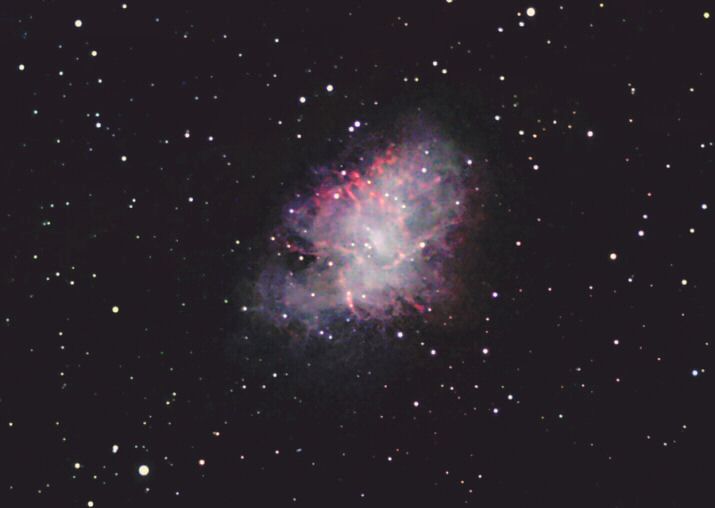
Date: 10/27/2003 - Location: Margate, FL Telescope: LX200GPS 12U - Camera: ST-10XME/AO-7 Exposure: L = 45 min. R & G = 10 min. B = 15 min. |
|
Discovered 1731 by British amateur astronomer John Bevis. The Crab Nebula is the most famous and conspicuous known supernova remnant, a cloud of gas created in the explosion of a star as supernova. The supernova was noted on July 4, 1054 A.D. by Chinese astronomers, and was about four times brighter than Venus. It was visible in daylight for 23 days, and 653 days to the naked eye in the night sky. Charles Messier independently found the nebula on August 28, 1758, when he was looking for comet Halley on its first predicted return, and first thought it was a comet. Of course, he soon recognized that it had no apparent proper motion, and cataloged it on September 12, 1758. It was the discovery of this object which caused Charles Messier to begin the compilation of his famous catalog. The nebula consists of the material ejected in the supernova explosion, which has been spread over a volume approximately 10 light years in diameter, and is still expanding at the very high velocity of about 1,800 km/sec. It emits light which consists of two major contributions. First, a reddish component which forms a chaotic web of bright filaments, which has an emission line spectrum like that of diffuse gaseous nebulae. Second a blueish diffuse background consisting of highly polarized `synchrotron radiation', which is emitted by high-energy electrons in a strong magnetic field. On November 9, 1968, a pulsating radio source, the Crab Pulsar, was discovered in M1 by astronomers of the Arecibo Observatory 300-meter radio telescope in Puerto Rico. It has now been established that this pulsar is a rapidly rotating neutron star. It rotates about 30 times per second. 1http://www.seds.org/messier/m/m001.html
|
