

| Date: 7/27/2011 - Location: Denton, TX Telescope: C14 Mount: MI-250 Filters: AstroDon Tru-Balance CRGB & 6nm Ha Camera: ST-10XME Exposure: L = 75 min. R, G & B = 75 min. each Ha = 60 min. Click on the image to view at higher resolution. |
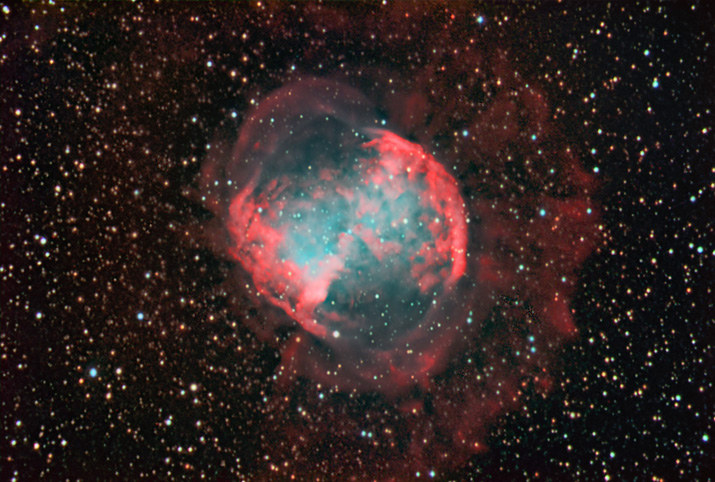
| Discovered by Charles Messier in 1764 M27, known as the Dumbbell Nebula, is the first planetary nebula ever discovered. It is very bright in relation to other planetary nebulae. The Helix Nebula has a total brightness greater than M27, but, as seen through an eyepiece, its large size and low surface brightness does not seem to out shine M27. M27 lies at an estimated distance of 1,200 light years in the constellation of Vulcepula. The nebula has a complex structure that consists of three shells of gas. The very faint outer halo of gas was probably expelled during the progenitor star's red giant stage. This faint halo is not readily visible unless imaged through a narrowband hydrogen alpha filter. In order to display this faint outer gas, the above image was processed using a composite of Ha filtered and normally filtered images. The inner, bright, parts of the nebula were ejected after the star ran out of nuclear fuel and its core collapsed. The resulting white dwarf, the small blue star in the center of the nebula, has a very high temperature of approximately 85,000 degrees and radiates strongly in the ultraviolet range. This intense radiation excites the ejected gas and results in the spectacular colors of the image above. The inner teal color of the nebula is primarily from excited oxygen known as OIII emission. The red areas are from excited hydrogen. |
