

|
Date: Nov. 12&15, 2026 - Location: Dark Sky Observatory, Fort Davis, TX Click on the image below to view at higher resolution. |
Scroll down to view the image description.
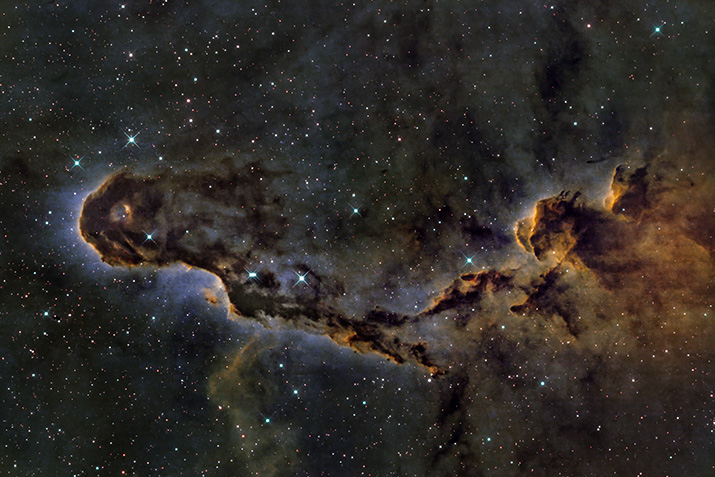
|
IC 1396A, commonly known as the Elephant's Trunk Nebula, is a dense concentration of interstellar gas and dust located within the much larger emission nebula IC 1396. It lies approximately 2,450 light-years away in the northern constellation Cepheus, the King[1]. The name Elephant's Trunk refers to the nebula's long, winding appearance. Recognizing familiar shapes in astronomical objects is a tradition extending back to ancient times, when observers associated patterns of stars with animals, people, and mythological figures. This tendency to perceive familiar forms in otherwise unrelated patterns is known as pareidolia. The Elephant's Trunk is a particularly striking example. This immense structure of gas and dust is also an active stellar nursery. Infrared observations made with NASA's Spitzer Space Telescope revealed young stellar objects embedded within the dark cloud, including protostars whose estimated ages range from approximately 100,000 to one million years[1,2]. Near the head of the Elephant's Trunk, two young stars, LkHα 349 and LkHα 349c, are associated with a cavity in the surrounding gas and dust. Stellar winds and radiation from these young stars contribute to the cavity's appearance. Meanwhile, the larger structure is being shaped by intense ultraviolet radiation from the massive O-type stellar system HD 206267, located outside the left edge of this image[1,3]. A Pair of Dogs in the Clouds? An amusing example of pareidolia can be found among the dark molecular clouds in the right-hand portion of this image. Two formations resemble dogs, one considerably larger than the other. The larger figure appears to have a projecting muzzle, drooping ears, and even a foreleg. Just above and to its right, a smaller dog seems to be looking toward its larger companion, with a recognizable snout and two pointed ears. Of course, these familiar shapes exist only in our interpretation of the intricate patterns of interstellar gas and dust. Nevertheless, they provide an entertaining reminder of how our minds recognize familiar objects in the unfamiliar structures of the universe. Can you find the two dogs? - [Take a closer look here.] The image above was assembled from three narrowband-filtered exposures, with sulfur II (S II) assigned to red, hydrogen-alpha (Hα) to green, and oxygen III (O III) to blue. The resulting false-color image uses the traditional Hubble palette. Stellar colors were incorporated using separately processed HOO (Hα-O III-O III) data. The HOO processed image may be viewed here. Image orientation: north up, east to the left.
Member of the Dark Sky Observatory Collaborative
References
|
