

|
Date: Jan. 16, 2026 - Location: Davis Mountains west of Fort Davis, TX
Click on the image to view at higher resolution. |
|
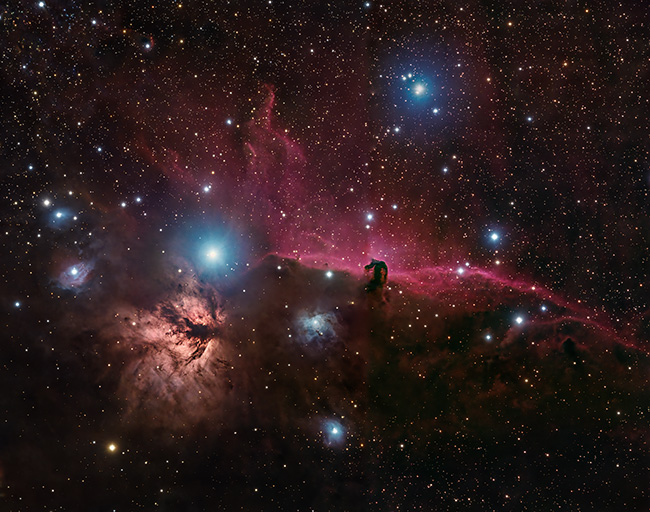
Alnitak, the easternmost star in Orion's Belt, dominates this wide field view. Located roughly 1,300 light-years from Earth[1], this massive blue supergiant is surrounded by a treasure trove of celestial wonders. IC434 is the large red emission nebula extending to the right of Alnitak. The illuminating source for the nebula is the bright star Sigma Orionis located in the upper center-right of the image. Perhaps the most famous is the Horsehead Nebula (B33)[1,2]. It is a dark cloud of obscuring matter silhouetted against IC434. The Horsehead was discovered in 1866 by Williamina Fleming while working at the Harvard College Observatory[5]. E. E. Barnard was one of the first to describe the nebula and included it in his catalog as B33[5]. Located below Alnitak is the impressive Flame Nebula (NGC 2024)[2]. It is brightly illuminated by intense radiation from Alnitak[1]. Obscuring dust, and intricate dark filaments, shape the Flame into a visible object that, to me, resembles the "Biblical Burning Bush". The core of the Flame is obscured by these dense dust clouds. Infrared observations using the James Webb Telescope reveal young stars and brown dwarfs that are invisible in visual light images[3]. Below the Horsehead, and a little to the left, is the Lump Star Nebula (NGC 2023). The Lump Star Nebula is also designated VdB 52[2] in Sidney van den Bergh's catalog[2]. Three other VdB reflection nebulae are also visible in the image. Below the Lump Star is VdB 57, just above and to the left of the Flame is VdB 51, and finally the faint blue nebula above VdB 51 is VdB 50. The image above is oriented with north to the left and east down.
Member of the Dark Sky Observatory Collaborative
References
|
