

|
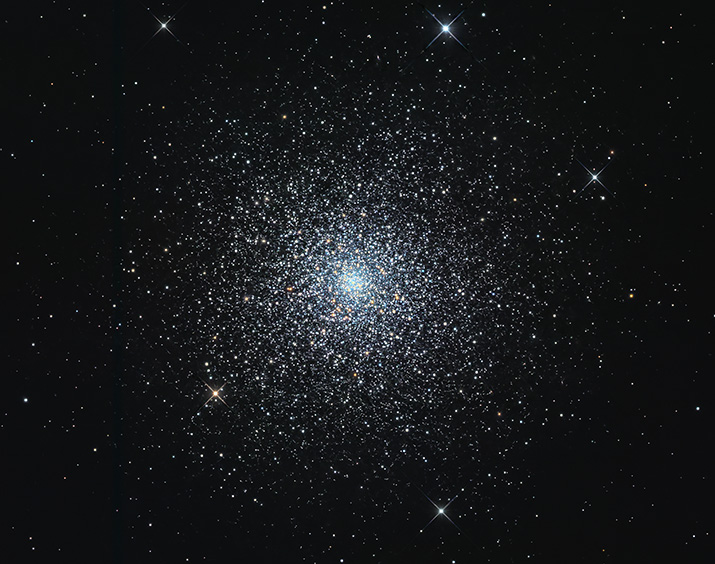
Date: April 17, 2026 - Location: Dark Sky Observatory, Fort Davis, TX Telescope: 16 inch RC - Camera: FLI 16803 Exposure: Luminance, Red, Green, and Blue = 24 x 30s each - bin 1x1 Click on the image below to view at higher resolution. |
Scroll down to view image description.
|
Discovered in 1764 by Charles Messier, M3 is one of the largest and brightest globular clusters in the northern sky[2]. It was also the first object in the Messier catalog discovered by Messier himself[1]. M3 contains an estimated 500,000 stars[1,2] and lies in the constellation Canes Venatici at a distance of approximately 34,000 light-years[1]. Although it lies farther away than the center of our galaxy, the Milky Way, it still shines at magnitude 6.2[3], making it faintly visible to the naked eye under very dark skies. The cluster's brightest stars have magnitudes around 12.7[3]. Its total mass has been estimated at about 245,000 solar masses (Sandage and Johnson)[3]; however, more recent work by Holger Baumgardt et al. (2023), using GAIA data, suggests a higher value of approximately 409,000 solar masses[3]. By fitting of M3's color-magnitude diagram, astronomers have determined its age to be about 11.8 billion years[3]. The cluster exhibits a relatively high metallicity for a globular cluster, indicating a notable abundance of elements heavier than hydrogen and helium[2]. M3 contains more variable stars than any other known globular cluster. A total of 274 variable stars have been identified[2], including 133 classified as RR Lyrae variables[2]. The cluster also hosts a significant population of Blue Straggler stars[3], which appear younger than the dominant stellar population. In dense stellar environments, such as globular clusters, stellar interactions and collisions are not uncommon[4]. When such interactions occur, two older stars can merge to form a more massive and hotter star[4] that appears to be much younger. This formation mechanism has been supported by studies of the nearby globular cluster 47 Tucanae using the Hubble Space Telescope[4].
Member of the Dark Sky Observatory Collaborative
References
|
