

|
Date: May 12-13-19, 2026 - Location: Dark Sky Observatory, Davis Mountains, TX Telescope: 16 inch RC Mount: Paramount MEII Camera: FLI 16803 Exposure: LRGB = 24x300 sec each filter - Bin 1x1 Click on the image below to view at higher resolution. |
Scroll down to view image description.
|
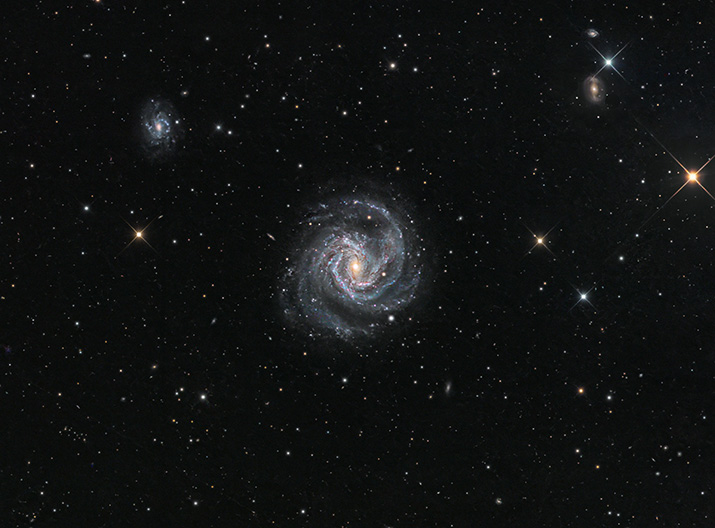
Note: This image is oriented with north to the top and east to the left.
Messier 61 (M61), also cataloged as NGC 4303, is a nearly face-on barred spiral galaxy located approximately 55 million light-years from Earth in the constellation Virgo[1]. One of the largest spiral galaxies in the Virgo Cluster, M61 spans about 100,000 light-years, making it comparable in size to our own Milky Way[1,3]. The galaxy is classified as SAB(rs)bc, indicating a weakly barred spiral structure with moderately wound spiral arms[3]. M61 is notable not only for its striking appearance but also for its scientific significance. The galaxy contains an active galactic nucleus and hosts a central supermassive black hole with an estimated mass of approximately five million solar masses[2,3]. Numerous regions of active star formation are visible in this image as pinkish-red knots scattered throughout the spiral arms. These regions consist primarily of ionized hydrogen gas energized by young, massive stars. M61 has also been the site of eight observed supernovae, making it one of the most prolific supernova-producing galaxies in the Messier Catalog[4].
Member of the Dark Sky Observatory Collaborative
References
|
