

|
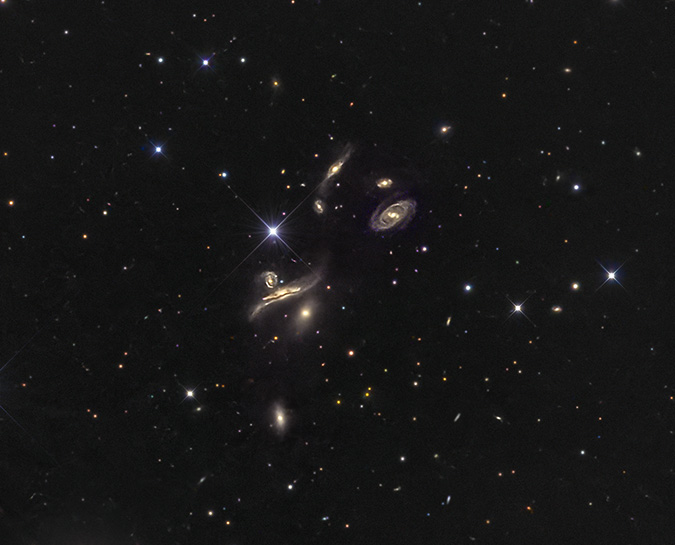
Date: May 8-9, 2026 - Location: Dark Sky Observatory, Davis Mountains, TX Telescope: 16 inch RC Mount: Paramount MEII Camera: FLI 16803 Exposure: Filters - Luminance, Red, Green, amd Blue = 24x300 sec. each - Bin 1x1 Click on the image below to view at higher resolution. |
Scroll down to view image description.
|
Note: This image is oriented with north to the top and east to the left.
Hickson Compact Group 57 (HCG 57), also known as Copeland's Septet and Arp 320, is a compact group of interacting galaxies located in the constellation Leo the Lion [2,4]. The group was discovered by Ralph Copeland in 1874 while serving as an observer for Lord Rosse in Ireland[1,2], and was later included by Dr. Paul Hickson in his catalog of compact galaxy groups as HCG 57[1]. Although traditionally referred to as a "septet," the system is now understood to contain at least eight gravitationally associated galaxies[2,4]. A Labeled image displaying the designations of the group's galaxies may be viewed here. The group lies at an estimated distance of approximately 430-480 million light-years from Earth[2,4]. The labeled image identifies the principal galaxies associated with the system. The largest and brightest member, NGC 3753 (HCG 57A), appears to have undergone a recent off-axis collision with the smaller spiral galaxy NGC 3754 (HCG 57D)[3]. Observations suggest that NGC 3754 passed through the disk of NGC 3753, producing the warped and highly disturbed morphology visible in the image[3]. X-ray observations obtained with the Chandra and XMM-Newton observatories reveal evidence of a gaseous bridge linking the two galaxies, supporting the interpretation of an ongoing gravitational interaction and shock-heated intergalactic gas[3]. Recent studies also indicate disturbed molecular gas kinematics and turbulent gas motions within the interacting system, suggesting that repeated close encounters may strongly influence both star formation and the long-term dynamical evolution of the group[3]. Compact galaxy groups such as HCG 57 provide important laboratories for studying galaxy evolution, tidal interaction, gas dynamics, and the cumulative effects of repeated close galactic encounters[1,2].
Member of the Dark Sky Observatory Collaborative
References
|
