

|
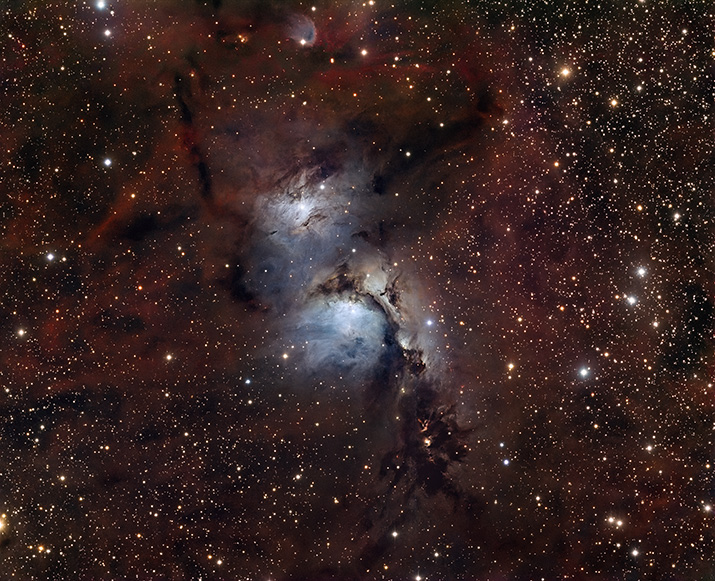
Date: 12-12-2025, 01-14-2026 & Location: Davis Mountains west of Fort Davis, TX Telescope: Telescope: Officina Stellare f/3 RH200-AT - Camera: QSI-640 - Mount: Paramount MX Exposure: L = 30 by 300s - RGB = 28 by 180 sec. each Filter All bin 1x1 Click on the image below to view at higher resolution. |
(Scroll down to view image discription.)
|
M78 (Messier 78), is the upper bright blue nebula in this image. It is also cataloged as NGC 2068 and is a reflection nebula discovered by Pierre Méchain in early 1780[1]. Charles Messier added it to his catalog on December 17, 1780[1]. This object resides within the Orion molecular cloud complex[1,2], an extensive region of gas and dust that also includes the Orion Nebula. As a reflection nebula, M78 shines by scattering and reflecting the light of nearby stars, producing its characteristic blue coloration. The illuminating sources are predominantly hot, young B-type stars[1], with the two brightest, HD 38563A and HD 38563B[1], in NGC 2068. Also visible are neighboring reflection nebulae embedded within the same molecular cloud complex. The prominent blue nebula in the lower central portion of this image is an active star-forming region and is cataloged NGC 2071. NGC 2064, visible near the upper edge slightly left of center, is another rather faint reflection nebula that is often overlooked in images of M78. The surrounding field is rich in dark dust lanes and filamentary absorption features particularly evident extending downward from NGC 2068 and across NGC 2071. These dense regions of molecular material obscures background starlight. Such obscuring clouds hide natal stars and protostars. Several Herbig-Haro objects have been identified within this region, particularly associated with M78 and NGC 2071[3], indicating ongoing star formation activity. These objects arise from collimated outflows of young stellar objects interacting with the surrounding medium, providing strong evidence that this region remains an active stellar nursery[3]. Distance estimates to M78 range from approximately 1,350[1] to 1,600[2] light-years. Continued spectroscopic and parallax measurements may help refine these values.
Member of the Dark Sky Observatory Collaborative
References
|
